Can Gorillas Learn Sign Language?
Can Gorillas Learn Sign Language?
The question “Can Gorillas Learn Sign Language?” has fascinated scientists, animal behavior researchers, conservationists, and wildlife enthusiasts for decades. Gorillas are among the most intelligent primates on Earth, sharing a close evolutionary relationship with humans. Their ability to communicate, solve problems, express emotions, and interact socially has led researchers to explore whether gorillas can truly understand and use human language systems such as sign language.
Over the years, several groundbreaking studies involving captive gorillas have demonstrated that gorillas can learn and use modified forms of sign language to communicate basic ideas, emotions, needs, and observations. These studies transformed public understanding of primate intelligence and sparked debates about animal consciousness, cognition, and communication.
Today, the story of gorilla sign language remains one of the most remarkable chapters in animal behavior science. At the same time, observing gorillas in the wild during gorilla trekking safaris in Uganda and Rwanda allows travelers to witness the incredible intelligence and social behavior that made these scientific discoveries possible.
For travelers interested in mountain gorillas, primate safaris, and wildlife experiences in East Africa, Monumental Expeditions and Safaris offers customized gorilla trekking adventures in Uganda and Rwanda.
Understanding Gorilla Intelligence
To answer the question “Can Gorillas Learn Sign Language?”, it is important first to understand gorilla intelligence.
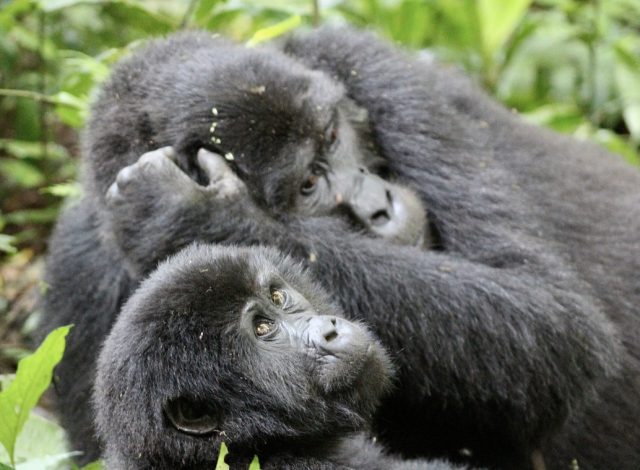
Gorillas are highly intelligent primates with advanced social structures, emotional complexity, and problem-solving abilities. They live in family groups led by dominant silverbacks and communicate through vocalizations, body language, facial expressions, and gestures.
Research has shown that gorillas can recognize individuals, form emotional bonds, remember routines, and even use tools in certain situations.
Their intelligence is one of the key reasons scientists believed gorillas might be capable of learning symbolic communication systems such as sign language.
Unlike humans, gorillas do not possess the vocal anatomy needed for spoken language. However, their hands are dexterous, making sign-based communication more accessible for scientific experiments.
The Famous Gorilla Koko and Sign Language
The most famous example connected to “Can Gorillas Learn Sign Language?” is Koko the gorilla.
Koko was a western lowland gorilla born in 1971 at the San Francisco Zoo. Under the guidance of researcher Dr. Francine Patterson, Koko became internationally known for learning a modified version of American Sign Language (ASL).
Over several decades, Koko reportedly learned more than 1,000 signs and could understand approximately 2,000 spoken English words.
Koko used signs to express emotions, request objects, describe experiences, and communicate with caregivers.
Examples of Koko’s communication included signs related to food, play, sadness, affection, and curiosity.
The project gained worldwide attention because it appeared to demonstrate that gorillas possess a level of symbolic understanding previously thought unique to humans.
How Gorillas Learn Sign Language
The process behind “Can Gorillas Learn Sign Language?” involves long-term interaction, repetition, and social bonding between gorillas and human trainers.
Gorillas are taught signs through observation, imitation, and positive reinforcement. Trainers repeatedly use hand gestures while associating them with objects, actions, or emotions.
For example, a trainer might repeatedly sign “drink” while giving water to the gorilla. Over time, the gorilla learns to associate the sign with the object or action.
Like human children learning language, gorillas often begin with simple concepts before progressing to more complex combinations of signs.
Researchers observed that some gorillas combined signs creatively to express ideas for objects they had not previously learned words for.
This ability suggested a level of conceptual thinking rather than simple memorization.
Did Gorillas Truly Understand Language?
One of the biggest scientific debates surrounding “Can Gorillas Learn Sign Language?” is whether gorillas truly understood language or simply mimicked learned behaviors.
Supporters of gorilla language research argue that gorillas demonstrated intentional communication, emotional expression, and creativity.
Critics argue that gorillas may have been responding primarily to cues from trainers or associating signs with rewards rather than understanding language grammar in the human sense.
While gorillas likely do not understand language at the same complexity level as humans, many scientists agree that they possess advanced cognitive abilities and meaningful symbolic communication skills.
The debate itself has significantly expanded scientific understanding of animal intelligence and communication.
Communication Among Wild Gorillas
Even without human-taught sign language, gorillas naturally possess sophisticated communication systems in the wild.
Understanding wild gorilla behavior provides important context to the question “Can Gorillas Learn Sign Language?”.
Mountain gorillas communicate through:
Vocalizations such as grunts, hoots, and barks
Chest beating displays
Facial expressions
Postures and gestures
Physical touch and grooming
Silverbacks use vocal and physical signals to maintain group order and protect family members.
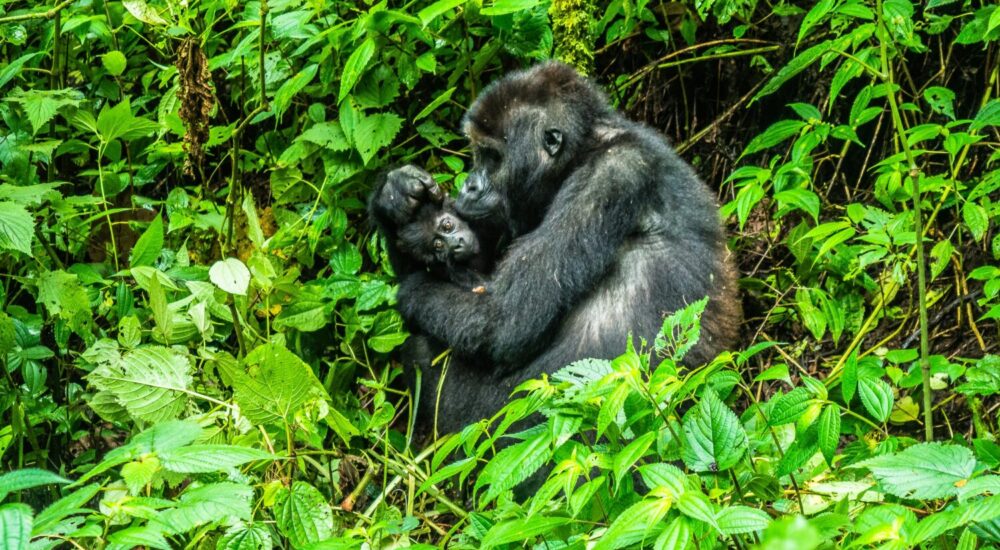
Mothers communicate gently with infants through touch and body positioning.
These natural communication abilities demonstrate the advanced social intelligence that makes gorilla sign language studies possible.
Emotional Intelligence in Gorillas
Another reason scientists became interested in “Can Gorillas Learn Sign Language?” is the emotional complexity displayed by gorillas.
Gorillas exhibit behaviors associated with empathy, affection, grief, playfulness, and social bonding.
Captive gorillas like Koko appeared capable of expressing sadness, joy, humor, and attachment through learned signs.
Wild gorillas also demonstrate emotional awareness through family interactions and caregiving behavior.
Observing these emotional dynamics during gorilla trekking safaris often leaves travelers deeply moved by how human-like gorillas can appear.
Gorilla Trekking and Gorilla Intelligence
Travelers who experience gorilla trekking in Uganda or Rwanda often gain firsthand appreciation for gorilla intelligence.
Watching mountain gorillas interact naturally in their forest habitat reveals complex social behavior, communication patterns, and emotional connections within families.
During trekking experiences, visitors may observe:
Juveniles playing and learning social skills
Mothers nurturing infants
Silverbacks monitoring group safety
Gorillas communicating through gestures and vocalizations
These encounters reinforce why gorillas became central to scientific studies about communication and cognition.
Gorilla Species and Language Research
Most sign language research has involved western lowland gorillas rather than mountain gorillas.
Western lowland gorillas are more commonly found in zoos and research facilities, making them more accessible for long-term studies.
Mountain gorillas, found primarily in Uganda, Rwanda, and the Democratic Republic of Congo, live in protected wild habitats and are not used in language experiments.
However, both species share high levels of intelligence and social complexity.
What Gorilla Sign Language Taught Scientists
Research connected to “Can Gorillas Learn Sign Language?” changed scientific understanding of primates in several important ways.
It demonstrated that non-human primates can:
Learn symbolic communication
Understand associations between signs and meanings
Express preferences and emotions
Use tools and solve problems
Display self-awareness and memory
These findings contributed to broader research on animal cognition and ethics.
They also increased public interest in gorilla conservation worldwide.
Conservation Impact of Gorilla Intelligence Research
The popularity of gorilla sign language studies helped raise awareness about endangered gorilla populations.
When people realized how intelligent and emotionally complex gorillas are, support for conservation efforts increased significantly.
Today, mountain gorilla conservation in Uganda and Rwanda depends heavily on tourism revenue generated through gorilla trekking.
Travelers who visit gorillas in the wild contribute directly to conservation programs, anti-poaching patrols, veterinary care, and local community development.
The question “Can Gorillas Learn Sign Language?” therefore also connects to broader conservation education and awareness.
Ethical Questions Around Gorilla Language Studies
Gorilla sign language research has also raised ethical questions about captivity, animal welfare, and human interaction with intelligent animals.
Some critics argue that highly intelligent primates should not be kept in captivity for research purposes.
Others believe such studies helped humans better understand and appreciate great apes, ultimately benefiting conservation.
Modern wildlife tourism increasingly focuses on ethical observation in natural habitats rather than captivity-based interactions.
This is one reason gorilla trekking in protected forests has become such an important conservation model.
Best Places to See Gorillas in the Wild
Travelers inspired by gorilla intelligence often choose to see gorillas in their natural environment.
The best destinations include:
Bwindi Impenetrable National Park in Uganda
Mgahinga Gorilla National Park in Uganda
Volcanoes National Park in Rwanda
Virunga National Park in DR Congo
Uganda remains the most popular destination due to its large mountain gorilla population and diverse safari options.
Gorilla Trekking as an Educational Experience
A gorilla trekking safari is more than a wildlife activity—it is also an educational journey into primate behavior and conservation.
Professional guides explain gorilla social structures, communication methods, feeding habits, and conservation challenges.
Many travelers leave with a deeper understanding of why gorillas became central to language and intelligence research.
Seeing gorillas in the wild often creates a stronger emotional connection than reading about scientific studies alone.
Why Choose Monumental Expeditions and Safaris
Planning a gorilla trekking safari inspired by the question “Can Gorillas Learn Sign Language?” requires expert guidance and logistical planning.
Monumental Expeditions and Safaris specializes in customized gorilla trekking safaris across Uganda and Rwanda.
The company organizes permits, transportation, accommodation, and professional guiding for unforgettable primate experiences.
Whether travelers seek gorilla trekking, chimpanzee tracking, or complete East African safaris, tailored itineraries are available.
Gorillas and the Future of Animal Communication Research
The question “Can Gorillas Learn Sign Language?” continues to inspire scientific curiosity and public fascination.
While debates remain about the depth of gorilla language understanding, there is no doubt that gorillas possess remarkable intelligence, emotional awareness, and communication abilities.
Research involving gorillas like Koko fundamentally changed how humans view great apes and their relationship to us.
Today, observing gorillas in the wild provides an even deeper appreciation for these extraordinary animals and reinforces the importance of protecting them for future generations.
Related Posts