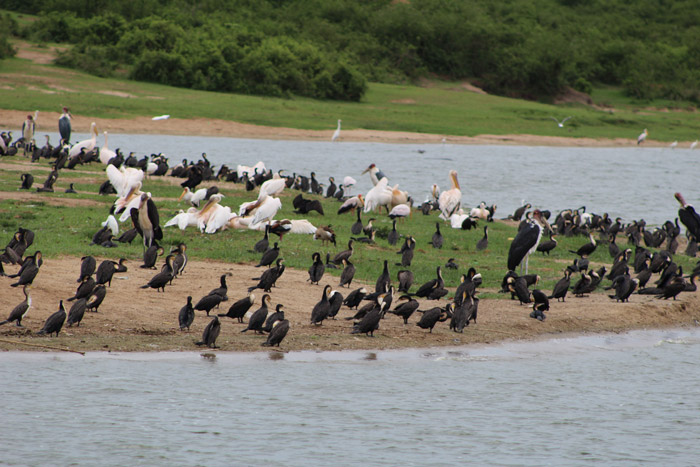
Murchison Falls National Park – Safari Overview Murchison Falls National Park, located in northwestern Uganda,…
L’Hoest’s Monkey: Uganda’s Mountain Forest Primate
L’Hoest’s Monkey: Uganda’s Mountain Forest Primate
Uganda is widely known for its mountain gorillas, chimpanzees, and classic savannah wildlife, but hidden within its dense mountain forests lives one of its most elegant and least discussed primates: the L’Hoest’s monkey. Scientifically known as Allochrocebus lhoesti, this shy and striking primate is a true gem of East Africa’s montane ecosystems and an important highlight for travelers interested in Uganda primate safaris beyond gorilla trekking.
Unlike more commonly spotted monkeys in African forests, L’Hoest’s monkeys are elusive, quiet, and highly forest-dependent. Their presence often indicates a healthy, undisturbed ecosystem, making them an important species for conservation and biodiversity studies in Uganda’s national parks.
For travelers exploring Uganda’s rainforests with Monumental Expeditions and Safaris, especially through experiences such as chimpanzee trekking or gorilla trekking, encountering L’Hoest’s monkey adds a fascinating layer of depth to the safari experience.
Understanding L’Hoest’s Monkey in Uganda’s Ecosystem
L’Hoest’s monkey is a medium-sized Old World monkey native to the montane forests of Central and East Africa. In Uganda, it is primarily found in forested regions such as Kibale Forest National Park, Bwindi Impenetrable National Park, and other high-altitude forest reserves.
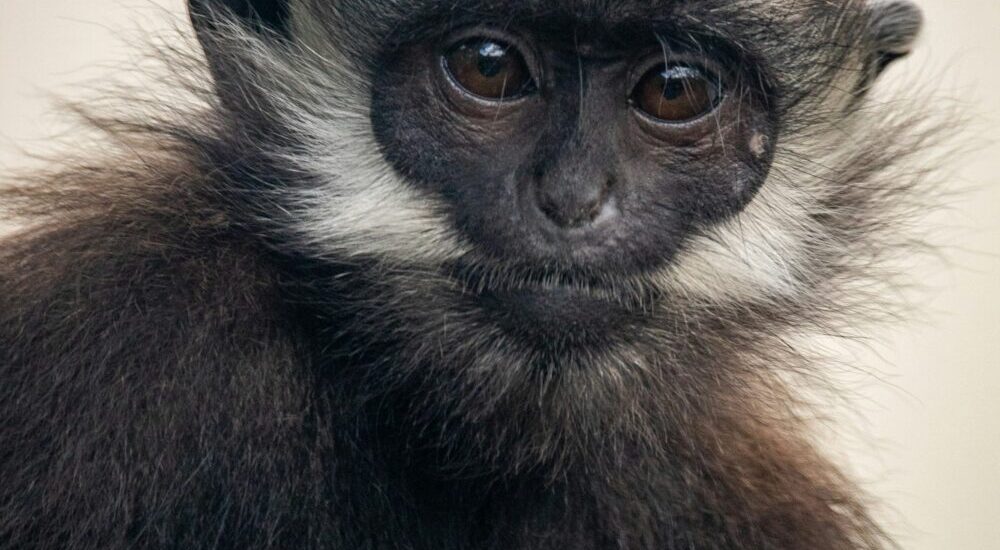
This primate is easily recognizable by its dark brown to black body, contrasting white beard, and pale chest patch. Its appearance is both elegant and distinctive, making it one of the most visually unique monkeys in Uganda’s forest ecosystem.
Unlike baboons or vervet monkeys that adapt easily to human presence, L’Hoest’s monkeys prefer dense forest cover and are rarely seen near open areas. This makes sightings special and highly rewarding for travelers on Uganda wildlife safari tours.
Their behavior is generally quiet and cautious. They move in small groups, often staying close to the forest canopy or undergrowth, and rely heavily on dense vegetation for protection.
Habitat and Distribution in Uganda
Uganda provides one of the most important habitats for L’Hoest’s monkey in Africa. The species thrives in montane and lowland forests where dense vegetation, moisture, and food sources are abundant.
Kibale Forest National Park is one of the best places to observe them. Known as the “primate capital of the world,” Kibale supports a rich diversity of primates, including chimpanzees, red colobus monkeys, and L’Hoest’s monkeys living within the same ecosystem.
Bwindi Impenetrable Forest also hosts populations of L’Hoest’s monkeys, particularly in areas where gorilla trekking routes pass through dense forest zones. Travelers on gorilla trekking Uganda safaris often encounter these monkeys while hiking through bamboo and montane forest sections.
Smaller populations are also found in forest reserves and protected areas across western Uganda, where conservation efforts continue to maintain habitat integrity.
Their preference for high-altitude forest environments makes them a key indicator species for healthy montane ecosystems.
Physical Characteristics and Unique Appearance
One of the most striking features of L’Hoest’s monkey is its contrasting facial markings. The species has a dark body coloration that blends perfectly with forest shadows, while its white beard and chest markings stand out clearly when observed closely.
Adult males tend to be larger than females, but both share similar coloration patterns. Their long tails are not prehensile but assist in balance during movement through dense vegetation.
Their eyes are particularly expressive, often appearing alert and intelligent, reflecting their cautious behavior in the wild.
For wildlife photographers on Uganda safari holidays, capturing L’Hoest’s monkey requires patience, as they rarely remain in open view for long periods.
Behavior and Social Structure
L’Hoest’s monkeys live in small social groups that usually consist of a dominant male, several females, and their offspring. Group sizes vary but typically remain smaller compared to more social primate species.
Their behavior is generally quiet and reserved. Unlike chimpanzees, which are vocal and highly expressive, L’Hoest’s monkeys communicate through subtle vocalizations, body posture, and movement within the forest canopy.
They are highly alert to predators and human presence, which explains their elusive nature. When threatened, they quickly retreat into dense vegetation, making sightings a rewarding challenge for attentive safari travelers.
Their diet consists mainly of leaves, fruits, seeds, and occasional insects. This makes them important seed dispersers within Uganda’s forest ecosystems, contributing to forest regeneration and biodiversity.
Role in Uganda’s Primate Tourism Experience
Although L’Hoest’s monkeys are not the main attraction for most visitors, they play an important supporting role in Uganda’s primate tourism ecosystem.
Travelers on chimpanzee trekking tours in Kibale Forest or gorilla trekking experiences in Bwindi often encounter L’Hoest’s monkeys along trekking routes. These incidental sightings add richness to the overall wildlife experience.
Their presence highlights the biodiversity of Uganda’s forests, reminding visitors that these ecosystems support far more than just the famous great apes.
For primate enthusiasts, spotting L’Hoest’s monkey becomes a special highlight, especially because of their elusive nature.
L’Hoest’s Monkey and Conservation in Uganda
Like many forest-dependent species, L’Hoest’s monkeys face threats from habitat loss, forest fragmentation, and human encroachment. However, Uganda’s strong conservation framework has helped protect key populations within national parks.
Protected areas such as Kibale Forest and Bwindi Impenetrable National Park provide secure habitats where populations can thrive under conservation management.
Tourism revenue from Uganda wildlife safaris and gorilla trekking permits contributes directly to conservation programs that benefit multiple primate species, including L’Hoest’s monkey.
Community-based conservation initiatives around forest edges also play a vital role in reducing human-wildlife conflict and promoting sustainable coexistence.
Their presence in Uganda’s forests is a positive indicator of ecosystem health, making their conservation important beyond tourism value.
Where to See L’Hoest’s Monkeys in Uganda
Travelers interested in observing L’Hoest’s monkeys in their natural habitat have the best chances in Uganda’s forested national parks.
Kibale Forest National Park remains the top destination due to its high primate density and well-established trekking infrastructure. Guided forest walks often reveal L’Hoest’s monkeys alongside chimpanzees and other primates.
Bwindi Impenetrable National Park also offers opportunities during gorilla trekking excursions, especially in areas where trekking routes pass through dense forest zones.
Mgahinga Gorilla National Park and select forest reserves in western Uganda may also host smaller populations.
While sightings cannot be guaranteed due to their elusive nature, experienced guides significantly increase the chances of encountering them during forest walks.
L’Hoest’s Monkey Compared to Other Ugandan Primates
Uganda is home to over 20 primate species, making it one of the richest primate destinations in Africa. Within this diversity, L’Hoest’s monkey occupies a unique ecological niche.
Unlike chimpanzees, which are highly social and vocal, L’Hoest’s monkeys are quiet and discreet. Compared to colobus monkeys, which are often seen leaping through the canopy, L’Hoest’s monkeys remain closer to the forest floor and mid-canopy layers.
Their behavior contrasts with baboons and vervet monkeys, which are more adaptable to open habitats and human presence.
This specialization makes them a valuable part of Uganda’s forest ecosystems and an interesting subject for primate safaris in East Africa.
Best Time to See L’Hoest’s Monkeys in Uganda
L’Hoest’s monkeys can be observed throughout the year in Uganda’s protected forests. However, wildlife viewing conditions are often easier during the dry seasons when forest trails are more accessible.
During wetter months, forest vegetation becomes denser, and although this enhances the natural environment, it can make sightings slightly more challenging.
Regardless of season, experienced guides increase the likelihood of sightings by tracking feeding patterns and group movements within known territories.
Combining L’Hoest’s Monkey Sightings with Gorilla and Chimpanzee Trekking
One of the unique advantages of traveling in Uganda is the ability to combine multiple primate experiences within a single itinerary.
A typical Uganda primate safari can include chimpanzee trekking in Kibale Forest, gorilla trekking in Bwindi, and forest walks where L’Hoest’s monkeys are frequently observed.
This combination creates one of the most diverse primate experiences available anywhere in the world.
Travelers gain insight into different behaviors, habitats, and ecological roles of Uganda’s primates, making the journey both educational and deeply engaging.
At Monumental Expeditions and Safaris, we design tailored itineraries that integrate these experiences seamlessly across Uganda’s top primate destinations.
Why L’Hoest’s Monkey Matters for Safari Travelers
Although often overshadowed by Uganda’s iconic gorillas and chimpanzees, L’Hoest’s monkey plays a crucial role in shaping the overall safari experience.
It represents the hidden biodiversity of Uganda’s forests, reminding travelers that every ecosystem contains layers of life beyond its most famous species.
For travelers seeking deeper understanding of African wildlife, encountering L’Hoest’s monkeys adds richness and context to broader safari experiences.
Their presence also reinforces the importance of protecting Uganda’s forests as interconnected ecosystems supporting multiple species.
Final Thoughts on Uganda’s Mountain Forest Primate
L’Hoest’s monkey may not be the most famous primate in Uganda, but it is one of the most fascinating. Its elusive behavior, elegant appearance, and deep connection to montane forest ecosystems make it a valuable part of Uganda’s biodiversity story.
For travelers exploring Uganda through gorilla trekking safaris, chimpanzee tracking, or forest walks, this species offers an additional layer of discovery that enhances the entire journey.
Uganda’s forests are not defined by a single species but by a complex web of wildlife interactions, and L’Hoest’s monkey is an essential part of that balance.
Visit Monumental Expeditions and safaris to plan your Uganda primate safari, gorilla trekking adventure, or customized East African wildlife experience.
Related Posts