uganda Safari Packages from Kigali, Rwanda – Gorilla, Wildlife, and Boat Safaris If you’re seeking…
How Dense Is Bwindi Impenetrable Forest?
How Dense Is Bwindi Impenetrable Forest?
Few places on Earth capture the imagination quite like Bwindi Impenetrable Forest. Located in southwestern Uganda, this ancient rainforest is globally famous as one of the last remaining strongholds of the endangered mountain gorilla. But beyond gorilla trekking, one question continues to fascinate travelers: how dense is Bwindi Impenetrable Forest?
The answer is simple in concept but extraordinary in reality. Bwindi Impenetrable Forest is one of the densest, most biologically complex rainforests in Africa, with vegetation so thick in some areas that sunlight barely reaches the forest floor. The name “Impenetrable” is not marketing language—it is a direct reflection of the forest’s physical structure, terrain, and ecological intensity.
Understanding this density helps explain why gorilla trekking in Bwindi is both challenging and deeply rewarding. It is not a manicured park with clear trails; it is a living, breathing ecosystem where every step is an encounter with raw, untouched nature.
Overview of Bwindi Impenetrable Forest
Bwindi Impenetrable National Park covers approximately 321 square kilometers of montane and lowland rainforest in southwestern Uganda, along the edge of the Albertine Rift Valley.
It is one of Africa’s oldest forests, estimated to be more than 25,000 years old, which makes it a refuge for thousands of species that evolved in isolation over millennia.
Bwindi is best known for its mountain gorillas, but its biodiversity extends far beyond primates. The forest is home to over 120 mammal species, 350 bird species, 200 butterfly species, and more than 1,000 plant species.
Its dense vegetation structure is a defining feature, shaping everything from wildlife movement to trekking difficulty.
Why Bwindi Is Called “Impenetrable”
The term “Impenetrable” in Bwindi Impenetrable Forest is not symbolic—it describes the actual physical density of the forest in many regions.
Historically, early explorers and local communities described Bwindi as nearly impossible to pass through due to its tangled vegetation, steep terrain, and thick undergrowth.
Even today, certain sections remain extremely dense, especially in lower elevation areas where vines, shrubs, and ferns form nearly continuous layers of vegetation.
This density is influenced by several natural factors:
High rainfall throughout the year
Rich volcanic soils
Minimal seasonal dry periods
Long-term forest stability without major disruption
Steep terrain that limits human access
Together, these conditions create a rainforest that grows in multiple vertical layers, from ground-level vegetation to towering canopy trees.
Understanding the Structure of Bwindi’s Density
To understand how dense Bwindi Impenetrable Forest is, it helps to break it down into its vertical structure.
The forest is layered into three main levels: the understory, mid-canopy, and upper canopy.
The understory is where density is most intense. This layer is filled with shrubs, vines, young trees, and thick ground vegetation. In many areas, visibility is limited to just a few meters.
The mid-canopy contains mature trees and climbing plants that intertwine, creating natural barriers that make movement slow and physically demanding.
The upper canopy consists of ancient trees that can reach significant heights, forming a dense green roof that filters sunlight and maintains humidity below.
This multi-layered structure is what makes Bwindi Impenetrable Forest density so unique compared to more open savannah ecosystems.
Ground Visibility and Trekking Experience
One of the most striking aspects of Bwindi’s density is how it affects visibility on the ground.
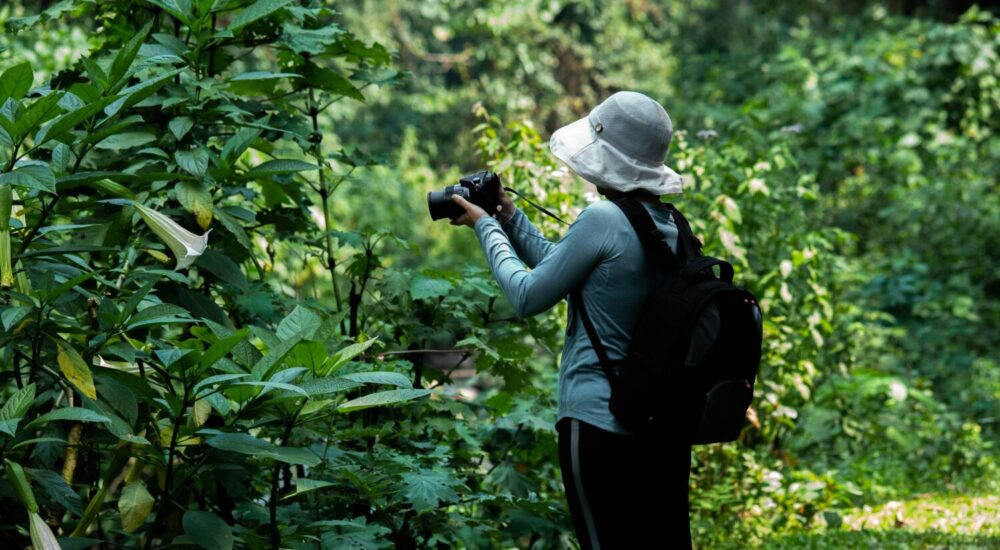
During Bwindi gorilla trekking, hikers often find themselves moving through narrow natural pathways surrounded by thick vegetation on both sides. In many sections, visibility is reduced to just a few meters ahead.
This creates an immersive experience where sound becomes more important than sight. Rustling leaves, distant bird calls, and occasional gorilla vocalizations guide trekkers through the forest.
The density also means that gorilla tracking is not predictable. Rangers must follow subtle signs such as broken branches, dung, and feeding patterns to locate gorilla families.
This makes every trek unique, shaped by the natural movement of wildlife within the dense forest environment.
Why Bwindi’s Density Matters for Gorillas
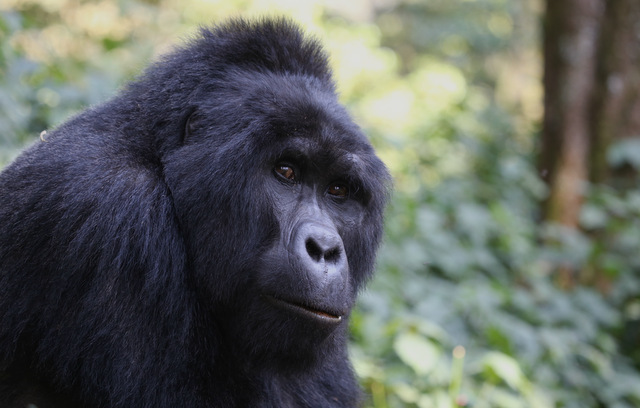
The extreme density of Bwindi Impenetrable Forest plays a critical role in the survival of mountain gorillas.
Dense vegetation provides natural protection from predators and human disturbance. It also offers abundant food sources, including leaves, shoots, and fruits.
Gorillas use the forest’s thick cover to build nests, travel between feeding areas, and raise their young in relative safety.
The density also helps regulate temperature and humidity, creating a stable microclimate that supports gorilla health.
Without this dense habitat, mountain gorillas would be far more vulnerable to environmental change and human encroachment.
Terrain and Its Role in Forest Density
Bwindi is not only dense because of vegetation—it is also shaped by its terrain.
The forest lies on steep ridges and valleys formed by the Albertine Rift. This uneven topography limits large-scale human access and allows vegetation to grow undisturbed.
Steep slopes contribute to rapid plant growth in certain areas, while valleys retain moisture that supports thick undergrowth.
This combination of elevation change and rainfall creates microhabitats that vary in density even within short distances.
Some sections of Bwindi feel almost like open forest corridors, while others are nearly wall-to-wall vegetation.
How Dense Is Bwindi Compared to Other Forests?
When comparing Bwindi Impenetrable Forest density to other African rainforests, it stands out as one of the most challenging environments to traverse.
Unlike Kibale Forest, which has more defined chimpanzee tracking trails, Bwindi has fewer clear paths and more natural obstacles.
Compared to Rwanda’s Nyungwe Forest, Bwindi is often considered denser in lower altitude regions, although both forests share similar montane characteristics.
Globally, Bwindi is comparable to parts of the Congo Basin in terms of vegetation thickness, though Bwindi is smaller and more accessible for tourism.
What makes Bwindi unique is the combination of extreme density and active gorilla tracking tourism, which requires carefully managed human access.
Seasonal Changes in Forest Density
The perceived density of Bwindi can change depending on the season.
During the rainy seasons, vegetation becomes even thicker due to rapid plant growth and increased moisture. Trails can become more enclosed as plants expand into walking paths.
During drier months, some sections become slightly more open, making trekking marginally easier, though the forest remains fundamentally dense year-round.
These seasonal variations do not significantly reduce Bwindi Impenetrable Forest density, but they do affect trekking comfort and accessibility.
Wildlife Movement in Dense Forest Conditions
Bwindi’s density influences how wildlife moves through the forest.
Mountain gorillas often create their own travel routes by bending vegetation and breaking branches, forming temporary paths within the dense undergrowth.
Other primates such as colobus monkeys and L’Hoest’s monkeys move primarily through the canopy, avoiding the dense ground layer.
Forest elephants, though rarely seen, create larger trails that subtly reshape vegetation patterns over time.
This constant interaction between animals and vegetation contributes to the dynamic structure of the forest.
Challenges Created by Bwindi’s Density
The same density that makes Bwindi unique also creates challenges for trekking.
Movement can be physically demanding due to uneven ground, slippery vegetation, and limited visibility.
Trekkers often need to use machete-cleared paths created by rangers and porters.
The forest floor can be muddy, especially after rain, requiring sturdy hiking boots and careful footing.
Despite these challenges, the density enhances the sense of adventure and discovery that defines Bwindi gorilla trekking experiences.
Conservation Value of Bwindi’s Density
The density of Bwindi is not just an environmental feature—it is a critical conservation asset.
Dense vegetation helps regulate the ecosystem, protect endangered species, and maintain biodiversity.
It also limits human encroachment, naturally preserving core gorilla habitats.
Bwindi’s classification as a UNESCO World Heritage Site is partly due to this intact and highly complex forest structure.
Without its density, the ecological balance that supports mountain gorillas would be significantly weakened.
Cultural and Historical Significance of the Forest
Local communities around Bwindi have historically respected the forest’s density and mystery.
Traditional beliefs often regarded the forest as a sacred or protected space due to its impenetrable nature.
Even today, surrounding communities play an important role in conservation efforts, supporting eco-tourism and gorilla protection programs.
The forest’s density has shaped not only its ecology but also the cultural identity of the region.
Why Bwindi’s Density Enhances Gorilla Trekking
While some travelers initially worry about how dense Bwindi Impenetrable Forest is, this very density is what makes gorilla trekking so rewarding.
Encounters with mountain gorillas feel more authentic because they occur in a truly wild and untouched environment.
The effort required to navigate the forest increases the emotional impact of finally locating a gorilla family.
Every trek becomes a journey through one of the most biologically rich ecosystems in the world.
Plan Your Bwindi Gorilla Trekking Safari
At Monumental Expeditions and Safaris, we design expertly guided Bwindi gorilla trekking safaris that help travelers experience the forest safely and comfortably despite its density.
Our itineraries ensure you are placed in the correct trekking sector—Buhoma, Ruhija, Rushaga, or Nkuringo—while providing experienced guides who understand the forest’s structure and movement patterns.
We also combine Bwindi experiences with Queen Elizabeth National Park safaris, Kibale chimpanzee tracking, and other Uganda wildlife adventures.
Start planning your Uganda gorilla trekking safari today with Monumental Expeditions and Safaris.
Related Posts