
Banded Mongoose
A tiny carnivore resembling a weasel. All mongooses are extremely gregarious, and they are frequently seen roaming in huge family groups.
- Range/Parks: They may be found across East and Central Africa, as well as a belt between the Sahara and the rainforests, where they have adapted to farming. Kingdon (page 247)
- Home Range: Packs have exclusive territories of up to 130 hectares, although there is always rivalry along territorial boundaries. Kingdon (page 248)
A pack will traverse 2-3 km per day in Uganda and up to 10 km per day in the Serengeti during a day of foraging. Estes (p. 316).
Termites, beetle larvae, and tiny vertebrates. Kingdon (page 248)
Millipedes, earwigs, ants, crickets, spiders, mice, toads, bird eggs, lizards, and snakes are also common. Vertebrates are only a minor portion of their diet. By licking wetted paws, water is taken sparingly. Estes (page 315)[/vcex_bullets]
A pack may have many breeding males at times. Seniority most likely determines dominant couples. Female children may remain in the natal pack, while male offspring often emigrate. Estes (page 315)
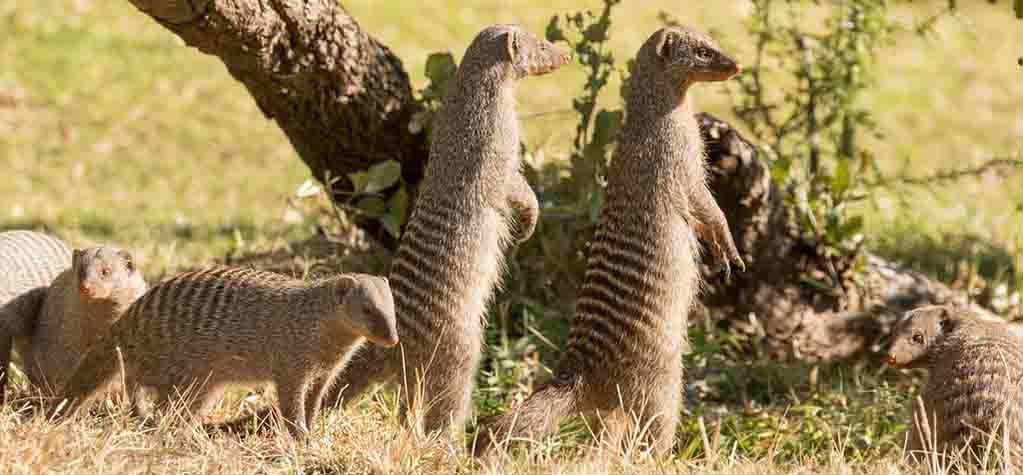 Males are more hostile against other packs and scent-mark their territory more frequently than females. Outsiders are rarely accepted into the packs, and in one study in Uganda, no outsiders joined the pack in three years. Estes (page 315)
If two packs from neighboring territories come across each other, they will usually just depart. If both groups try to spend the night in the same den, the bigger group will chase the smaller group away. Equally matched packs may engage in combat. Fights are noisy and intense, and they can persist for several hours. Estes (p. 316).
When foraging, groups disperse but remain connected through vocalizations. They scratch up the litter, investigate every hole and opening, and turn over pebbles and manure. They can detect invertebrates beneath the ground’s surface and will dig to get them. An individual is protective of a newly discovered food source, yet it can’t help but make an ecstatic sound when it finds one, bringing the rest of the group with it. Estes (p. 316).
If a predator approaches, a pack will launch a threatening mobbing attack. They have been observed to mob bushbucks, geese, and other non-threats in order to discourage predators as large as servals or large dogs. They move as a growling, writhing mass, and will even follow a predator who has kidnapped a pack member in order to return it. Estes (page 318)
Dens: In one research, more than half of the 144 analyzed den sites were in thickets, primarily in termite mounds, 21% in erosion gulleys, 15% in open termite mounds near cover, 11% in open holes, and 3% were constructed by humans. Dens had 1-9 entrances and tunnels that led up to 210 cm into the den. The tunnel sizes were around 9 cm. They led to chambers 150 x 90 cm in size and 50 cm in height. Estes (page 315)
Anal-gland scent-marking is a common mode of communication. Every day, stones, stumps, termitaries, and group members are noted. A mongoose will display its banded rump, stimulating scent-marking by another mongoose. A “communal stench” was shared by the entire pack. Kingdon (page 248)
A wide range of vocalizations are available. As contact beckons, soothing chitters and churrs, explosive chattering and shrieking for anger or menace.
Activity is strictly diurnal. Kingdon (page 247)
Pack emerges roughly an hour after sunrise after spending the night together in a den for warmth. They pop their heads out, sniff the air, and return if it is safe. They relieve themselves at a communal toilet before spending time playing and grooming each other before starting to graze. They take a rest break in the shade throughout the day after 2-3 hours of hard feeding. From 4 p.m. to shortly before sundown, there is an afternoon activity period. Estes (p. 316).
- Estes (1991). The African Mammal Behavior Guide. The University of California Press, Berkeley, CA.
- Kingdon (1997). The African Mammal Field Guide by Kingdon. Princeton University Press, Princeton, New Jersey.
- Walker (1996). Signs of the Wild: A Field Guide to the Spoor and Signs of Southern African Mammals. Fifth Edition. Struik Publishers Ltd. is based in Cape Town, South Africa.