Exploring the Big Five in Uganda: Where to Find Them Introduction to Uganda’s Big Five…
Cheetah vs Leopard: What’s the Difference?
Cheetah vs Leopard: What’s the Difference?
When it comes to Africa’s majestic big cats, the cheetah and the leopard are two of the most iconic and captivating predators. Although these two felines are often confused due to their spotted coats and similar habitats, they have distinct physical characteristics, behaviors, and hunting strategies that set them apart.
Introduction to Cheetahs and Leopards
What is a Cheetah?
The cheetah (Acinonyx jubatus) is renowned worldwide as the fastest land animal, capable of reaching speeds of up to 75 mph (120 km/h) in short bursts. It is a slender, graceful cat built for speed rather than power. Cheetahs primarily hunt during the day, relying on their remarkable acceleration to catch swift prey like gazelles.
What is a Leopard?
The leopard (Panthera pardus), on the other hand, is a powerful and adaptable big cat found throughout sub-Saharan Africa and parts of Asia. Leopards are stealthy ambush predators, relying on their strength and camouflage to stalk prey, often hunting at night. They are known for their exceptional climbing ability, frequently dragging their kills into trees to avoid scavengers.
Physical Differences Between Cheetahs and Leopards
Size and Build
- Cheetah: Slim, long-legged, and built for speed. Adult cheetahs weigh between 35-72 kg (77-159 lbs) and measure about 1.1 to 1.5 meters (3.6 to 4.9 feet) in body length.
- Leopard: Stockier and more muscular, built for power and stealth. Adult leopards weigh 30-90 kg (66-198 lbs) and have a body length ranging from 1.3 to 1.7 meters (4.3 to 5.6 feet).
Coat Pattern
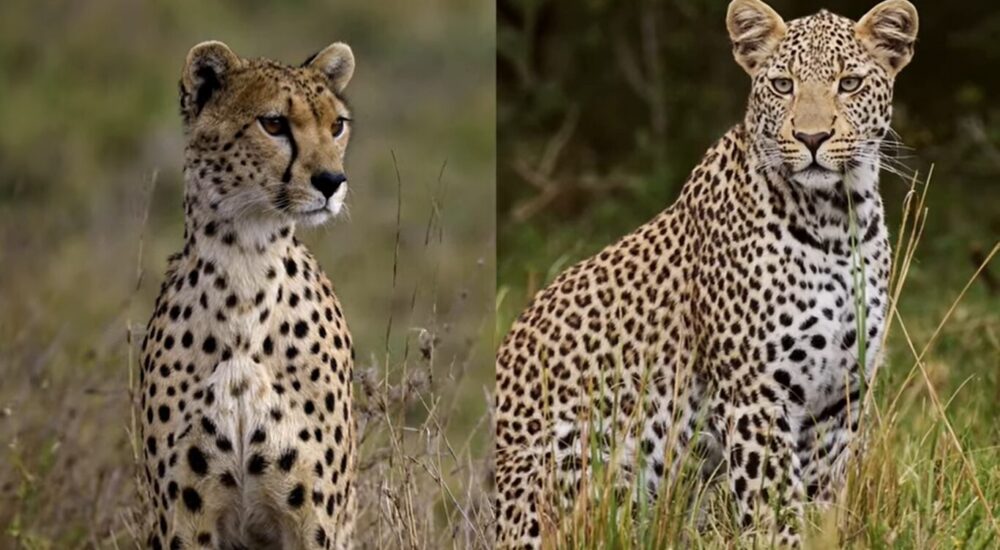
The cheetah has small, solid black spots evenly distributed across a tan or yellowish coat.
The leopard has rosette-shaped spots—clusters of black spots forming circles with a lighter center, providing better camouflage in dense foliage.
Facial Markings
The cheetah sports distinctive “tear marks”—black lines running from the inner corners of the eyes down to the mouth. These help reduce glare from the sun and aid in focusing on prey during high-speed chases.
The leopard lacks tear marks but has a more pronounced, broad face with whiskers and stronger jaw muscles.
Behavior and Hunting Techniques
Cheetah Behavior
Cheetahs are diurnal hunters, active during the day when many other predators are resting. They rely on exceptional eyesight to spot prey from a distance and then use explosive speed to sprint and catch it in short chases, usually lasting less than 30 seconds.
Example: In the Serengeti National Park, cheetahs hunt Thomson’s gazelles using stealthy stalking followed by a rapid burst of speed to outrun their prey.
Leopard Behavior
Leopards are nocturnal and crepuscular (active at dawn and dusk), using stealth and patience to ambush prey. They are solitary animals, fiercely territorial, and excellent climbers. Leopards often stash their kills in trees, protecting them from hyenas and lions.
Example: In Kruger National Park, leopards have been observed dragging impalas and other prey high into acacia trees to avoid scavengers.
Habitat and Distribution
Cheetahs prefer open savannas, grasslands, and semi-desert regions where they can maximize their speed advantage.
Leopards are more adaptable, thriving in diverse habitats, including savannas, forests, mountains, and even urban fringes.
Vocalizations and Communication
Cheetahs communicate using high-pitched chirps, purrs, and growls but cannot roar.
Leopards can roar, growl, and produce a distinctive rasping cough.
Conservation Status and Threats
The cheetah population is vulnerable due to habitat loss, human-wildlife conflict, and loss of prey, with an estimated wild population around 7,000 individuals.
The leopard population is more stable but faces threats like habitat fragmentation and poaching.
How to Tell a Cheetah from a Leopard in the Wild
- Look for the tear marks on the face (cheetah).
- Observe the spot pattern — solid spots (cheetah) versus rosettes (leopard).
- Notice body build — lean and aerodynamic (cheetah) versus muscular and stocky (leopard).
- Behavior — cheetahs run in open daylight, leopards stalk and climb in dense cover.
- Vocalizations — cheetahs chirp, leopards roar.
Where to See Cheetahs and Leopards
Best Places to See Cheetahs
- Serengeti National Park, Tanzania
- Masai Mara National Reserve, Kenya
- Kgalagadi Transfrontier Park, South Africa/Botswana
- Okavango Delta, Botswana
Best Places to See Leopards
- Kruger National Park, South Africa
- Sabi Sands Game Reserve, South Africa
- Yala National Park, Sri Lanka
- Maasai Mara National Reserve, Kenya
Interesting Facts About Cheetahs and Leopards
- Cheetahs cannot roar but are the fastest runners on land.
- Leopards are incredibly strong climbers and can carry prey twice their weight up trees.
- Cheetah cub mortality is very high due to predation by lions, hyenas, and other predators.
- Leopards have the widest range of any big cat species.
Conclusion: Cheetah vs Leopard — Which Big Cat Fascinates You More?
Both the cheetah and leopard are incredible examples of evolutionary adaptation, with their own unique skills and survival strategies. While the cheetah dazzles with speed and grace, the leopard captivates with power and stealth.
Next time you embark on an African safari, keep these differences in mind to spot and appreciate these magnificent felines in their natural habitat.
Plan your trip, now!
Related Posts