
Top 10 Best Luxury Hwange Safari Lodges & Camps Hwange National Park, Zimbabwe's largest and…
5 Fabulous Facts of the Greater Kudu (Tragelaphus Strepsiceros)
5 Fabulous Facts of the Greater Kudu (Tragelaphus Strepsiceros)
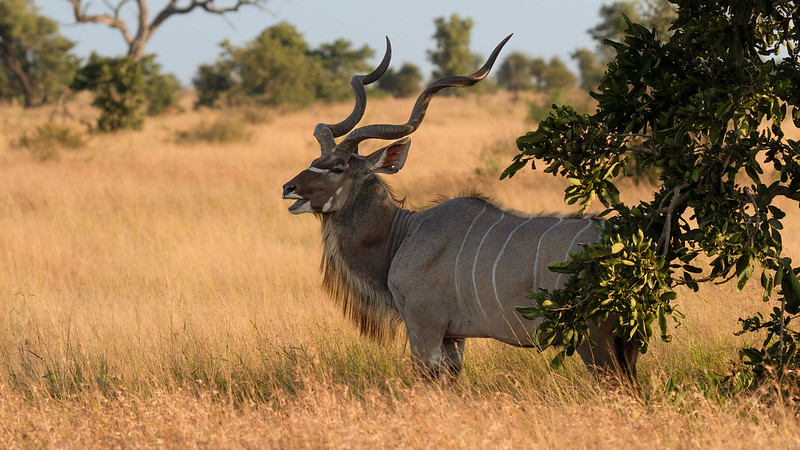
Africa is our passion at Monumental Expeditions and Safaris Not just for the big five, either. We’ll examine the Greater Kudu in more detail today. This attractive antelope, which has the longest spiral horns of any antelope, has long been a favorite among trophy hunters and safari travelers.
Bulls can weigh more than 250 kg and stand 1.5 meters at the shoulder. They are members of the Tragelaphus genus, which also includes bushbuck and nyala. Despite their size, they are rather light in build and well-known for their ability to leap, easily clearing fences and other obstacles.
Habitat and Distribution
Although minor populations of three distinct subspecies can be found in East Africa, the Horn of Africa, and the southern Sahara, this species is most prevalent in Southern Africa. Its preferred habitat is rocky bush terrain and moderately wooded savanna, where it usually hides from predators like lions, leopards, hyenas, and wild dogs.
Facts about Greater Kudu
Kudu are notoriously difficult to approach and extremely vigilant. They produce a hoarse alarm bark when they sense danger, usually with the help of their big, radar-like ears. Then, they run away in a characteristic rocking-horse motion, with the male putting back his horns to avoid obstacles above.
The native Khoikhoi language of Southern Africa is the source of the popular term kudu. The scientific term is Greek in origin: Keras means “horn,” Strephis means “twisting,” and Tragos means “he-goat,” while Elaphos means “deer.”
A adult bull kudu’s horns have two and a half twists and would be 120 cm long on average if straightened. On occasion, though, they might have three complete twists, and their record length is an incredible 187.64 cm. The horns don’t start to grow until the bull is between six and twelve months old. They twist once around the age of two and don’t achieve the full two-and-a-half twists until the bull is six years old. They have historically been used as ornaments and musical instruments by various traditional cultures, such as the shofar, a Jewish ritual trumpet played on Rosh Hashanah.
Although they are rarely physically hostile, male kudus may push one another with their horns during the courtship season. Sometimes during these competitions, their horns get entangled, and both men may perish if they are unable to untangle them.
The Afrikaner community in South Africa participates in the traditional sport of kudu dung-spitting, known as bokdrol spoeg in Afrikaans. With the distance estimated to the antelope’s resting place, the candidate who can spit one of the little, hard dung pellets the furthest wins. In 1994, a yearly world championship was established, with competitions taking place at game festivals, community gatherings, and travel exhibitions. Shaun van Rensburg Addo established the world record in 2006, and it stands at 15.56 meters.
Conservation Status of Greater Kudu
The African Wildlife Foundation lists the kudu as Near Threatened, with only about *118,000 individuals remaining in the wild. These graceful antelopes face multiple threats, including poaching for their meat, hides, and prized spiral horns. Locals often repurpose kudu horns to craft musical instruments, store honey, or use them in traditional ceremonies. Sadly, habitat loss further endangers their survival. Promoting wildlife awareness and responsible eco-tourism plays a vital role in protecting these incredible animals for future generations.
Where to See Kudus in the Wild
The greater kudu thrives across southern Africa, and some of the best places to spot them include Kruger National Park in South Africa, Etosha National Park in Namibia, and Zambia’s top national parks. For those exploring East Africa, Ruaha National Park and Selous Game Reserve in Tanzania offer rare sightings of the region’s unique East African kudu subspecies.
Related Posts